


— Look, I get it. You’ve been told your whole life that you need to “stay positive” and “look on the bright side.” Every self-help book and motivational speaker seems to preach the same gospel: positive vibes only, manifest your dreams, and whatever you do, don’t be a downer. But here’s what nobody’s telling you: this relentless pursuit of positivity might actually be making you miserable. Think about it. When was the last time you felt genuinely sad, angry, or disappointed, and instead of just feeling it, you immediately tried to talk yourself out of it? “I shouldn’t feel this way.” “Other people have it worse.” “I need to be grateful.” Sound familiar?
This post contains Amazon affiliate links, meaning I may earn a small commission if you purchase through my links, at no extra cost to you. Note: We aim to provide accurate product links, but some may occasionally expire or become unavailable. If this happens, please search directly on Amazon for the product or a suitable alternative.
You’re crucially telling yourself that your feelings are wrong. And that’s where the tyranny begins. The Problem With Toxic Positivity When you force yourself to slap a smile on every situation, you’re not actually dealing with anything. You’re just putting a band-aid over a wound that might need stitches. That frustration at work? That grief you’re carrying? That anxiety keeping you up at night? They don’t disappear just because you post an inspirational quote on Instagram. In fact, pushing down your negative emotions is like trying to hold a beach ball underwater. It takes constant energy, and eventually, it’s going to pop back up – usually at the worst possible moment.
Here’s something that might blow your mind: your so-called “negative” emotions aren’t actually negative. They’re neutral messengers carrying important information. Anger tells you when your boundaries have been crossed. Sadness helps you process loss and signals when you need support. Anxiety alerts you to potential threats and helps you prepare. Fear keeps you safe. Even jealousy can show you what you truly want in life. When you constantly override these signals with forced positivity, you’re ignoring the check engine light on your dashboard. Sure, you can put a sticker over it, but that doesn’t mean your engine isn’t about to blow.
Let’s talk about how tired you are. Not just physically tired – emotionally exhausted. Because maintaining this facade of constant positivity is work. It’s a performance, and you’re doing it all day, every day. You’re sad but you smile. You’re overwhelmed but you say you’re “blessed.” You’re struggling but you post about your gratitude practice. And underneath it all, there’s this growing sense of disconnection – from yourself, and from others who can’t seem to relate to your perfectly curated positivity. Real connection happens in the messy middle. It happens when you admit you’re not okay and someone says, “Me too.” That’s where genuine human bonding lives – not in the highlight reel, but in the honest moments. Here’s your permission slip: you’re allowed to feel bad, it’s part of our human emotions.
Understanding Positivity
Positivity has become the emotional currency of our time, but somewhere along the way, it morphed from a helpful mindset into an oppressive demand. You’ve probably felt it—that subtle pressure to smile through your struggles, to find the silver lining when you’re barely holding on, to perform happiness even when your world feels like it’s crumbling. This shift didn’t happen overnight, and understanding how we got here is the first step toward breaking free from its grip.
Tired of being told to “just think positive”?
What if the pressure to be positive itself is what’s making you feel worse? This isn’t another post about forcing a smile. It’s a deep dive into why “good vibes only” can be toxic—and how to find a more honest, sustainable kind of peace.
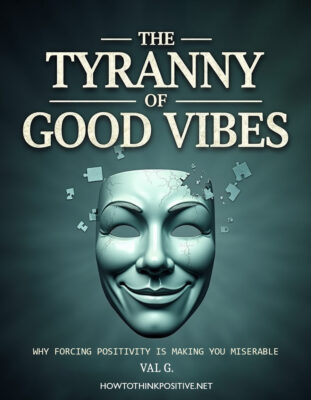
Ready to take your journey to the next level? 🌟 Download the Enhanced PDF Version of “The Tyranny of Good Vibes: Why Forcing Positivity Is Making You Miserable” today! Packed with exclusive key takeaways, a hands-on exercise, and bonus tips, this guide is your ultimate resource for breaking free from toxic positivity.
✨ What’s Inside?
✔️ Deep Insights: Key takeaways that go beyond the original article.
✔️ Practical Exercise: A step-by-step action plan to help you embrace authenticity.
✔️ Bonus Tips: Expert advice to kickstart your journey to genuine self-growth.
📥 How to Get It:
Sign up for the How To Think Positive newsletter and gain immediate access. Share it with friends and family—because real growth is better together!
🚀 Your Journey Starts Now:
Don’t wait to rewrite the rules of self-growth. Download your enhanced guide and take the first step toward a more balanced, authentic you.
The Definition of Toxic Positivity

Toxic positivity is the overgeneralization of a happy, optimistic state that rejects all negative emotions. It’s when someone tells you “everything happens for a reason” after a devastating loss, or when you’re expected to “stay positive” while facing genuine hardship. Unlike authentic optimism, which acknowledges difficulties while maintaining hope, toxic positivity denies your reality and invalidates your emotional experience. It’s positivity weaponized against your truth.
The Evolution of Positivity in Society
The modern positivity movement exploded in the late 20th century with the rise of self-help culture and motivational speaking. What started as Norman Vincent Peale’s “power of positive thinking” in the 1950s evolved into a multi-billion dollar industry. By the 2000s, books like “The Secret” convinced millions that thoughts alone could manifest reality, turning positivity from a mindset into a moral obligation.
This evolution accelerated with social media, where curated feeds showcase only highlight reels, creating an impossible standard. Your Instagram feed became a positivity echo chamber, where vulnerability was carefully staged and authentic struggle was filtered out. The wellness industry capitalized on this shift, selling you gratitude journals and affirmation cards while suggesting that if you’re not thriving, you’re simply not trying hard enough. Corporate culture adopted this language too, rebranding overwork as “hustle culture” and exhaustion as a sign you’re not sufficiently passionate about your purpose.
The Cultural Factors Contributing to the Good Vibes Mandate
Several cultural forces converged to create today’s positivity tyranny. Economic instability made employers favor workers who could “stay positive” through pay cuts and increased workloads. Social media algorithms rewarded uplifting content while burying posts about struggle. The self-help industry grew into a $13.2 billion market, profiting from your belief that happiness is always one purchase away. Consider these contributing factors:
- Hustle culture glorifying constant productivity and optimism
- Influencer economy monetizing carefully curated joy
- Workplace expectations demanding emotional labor alongside physical work
- Consumer capitalism linking happiness to purchasing power
Assume that questioning these forces makes you more emotionally intelligent, not negative.

Your discomfort with forced positivity isn’t personal failure—it’s a rational response to unrealistic expectations. The cultural mandate for good vibes serves specific purposes: it keeps workers compliant, consumers spending, and people blaming themselves rather than examining systemic problems. When you’re told your mindset is the problem, you stop questioning why wages haven’t kept pace with inflation or why healthcare is inaccessible. You internalize failure instead of recognizing that the game is rigged. The factors perpetuating this include:
- Productivity culture equating your worth with output
- Wellness industry selling solutions to manufactured problems
- Digital platforms amplifying comparison and inadequacy
- Economic systems benefiting from your self-blame
Assume that recognizing these patterns is the beginning of your liberation from them.
The Different Types of Positivity
Not all positivity wears the same mask. You’ve encountered the cheerleader who dismisses your struggles, the friend who genuinely celebrates your wins, and the colleague who plasters on fake smiles during difficult meetings. Each represents a distinct flavor of positivity, and understanding these variations helps you navigate emotional landscapes more honestly. Some positivity lifts you up while other types suffocate your authentic feelings under layers of forced cheerfulness. Recognizing these patterns transforms how you respond to both your inner dialogue and external pressure. Perceiving the difference between genuine encouragement and toxic dismissal becomes your compass for emotional wellbeing.
| Type of Positivity | Core Characteristic |
|---|---|
| Authentic Positivity | Acknowledges reality while maintaining hope and genuine optimism |
| Toxic Positivity | Dismisses negative emotions and insists on forced cheerfulness |
| Defensive Positivity | Uses upbeat attitudes as armor against uncomfortable truths |
| Performative Positivity | Displays happiness for social approval rather than genuine feeling |
| Conditional Positivity | Offers support only when circumstances meet specific expectations |
Authentic Positivity vs. Toxic Positivity
Authentic positivity holds space for your pain while believing in your capacity to move through it. When your friend says “this situation really hurts, and I’m here while you figure it out,” that’s the real deal. Toxic positivity, on the other hand, slaps a band-aid over a wound that needs stitches, insisting you smile through genuine suffering. It shows up as “everything happens for a reason” when you’ve just experienced loss, or “look on the bright side” when you need someone to simply witness your struggle. The difference lies in permission—authentic positivity gives you permission to feel everything, while toxic positivity demands you feel only acceptable emotions.
The Spectrum of Emotional Responses
Your emotional range exists on a spectrum far richer than simple happy-or-sad binaries. Between pure joy and deep despair live countless nuanced feelings: contentment, melancholy, frustration, peace, anxiety, and everything in between. You might feel simultaneously grateful for your job and exhausted by its demands. You can love someone deeply while feeling angry about their choices. These contradictions don’t make you confused—they make you human. Honoring this complexity means you stop trying to flatten your emotional experience into socially acceptable soundbites.
Think of your emotions as a color palette rather than a light switch. You wouldn’t paint a sunset using only yellow, yet you’ve been taught to express only brightness. Your darker shades—the blues, grays, and deep purples—add depth and dimension to your emotional landscape. When you allow yourself the full spectrum, you discover that sadness can coexist with hope, that anger can fuel positive change, and that acknowledging fear doesn’t mean surrendering to it. This broader perspective frees you from the exhausting performance of constant cheerfulness and invites more authentic connections with others who are equally tired of pretending.
Identifying Your Own Positivity Triggers
Your body knows when positivity turns toxic before your mind catches up. Notice the tightness in your chest when someone tells you to “just be grateful” during a hard time, or the flash of irritation when you encounter another inspirational quote that feels hollow
The Pressure of the Positive Mindset
You’ve probably felt it—that gnawing guilt when you’re having a bad day and someone chirps, “Just think positive!” The relentless push to maintain an upbeat attitude has become exhausting. Everywhere you turn, there’s another message insisting you should be happier, more grateful, more optimistic. This constant pressure doesn’t lift your spirits; it amplifies your stress. When you’re already struggling, being told to simply “choose happiness” feels like being handed a self-help book when what you really need is genuine understanding and space to feel what you’re feeling.
Social Media Influence and Highlight Reels
Your Instagram feed is a carefully curated museum of other people’s best moments. Everyone’s on vacation, landing promotions, or having picture-perfect brunches while you’re in sweatpants eating cereal for dinner. These digital highlight reels create an impossible standard that makes your ordinary life feel inadequate. You’re comparing your behind-the-scenes reality to everyone else’s polished performance, and that comparison is stealing your contentment. The endless scroll of manufactured joy leaves you feeling like you’re the only one not living your best life.
The Self-Help Industry’s Role
The self-help industry has ballooned into a $13.2 billion market, and it’s built on a simple promise: you’re broken, but their product can fix you. These motivational speakers and wellness gurus profit from your insecurity while selling you the idea that happiness is just one purchase, one mantra, one morning routine away. The message is always the same—if you’re not thriving, you’re simply not trying hard enough.
What’s particularly troubling is how this industry pathologizes normal human emotions. Feeling sad? Buy this course. Experiencing anxiety? Subscribe to that program. The underlying assumption is that negative emotions are problems to be solved rather than natural responses to life’s challenges. This creates a cycle where you’re constantly seeking the next solution, the next breakthrough, the next gratitude journal that will finally make everything click. Meanwhile, you’re spending money and energy fighting against your own emotional reality instead of learning to navigate it with compassion and wisdom.
Workplace Culture and Its Impact on Mental Health
Your office has probably adopted that relentlessly cheerful corporate culture where every challenge is an “opportunity” and every setback is a “learning experience.” Team-building exercises force enthusiasm, while managers expect you to bring positive energy even when you’re overwhelmed. This workplace pressure to perform happiness alongside your actual job duties creates emotional exhaustion. You’re not just working—you’re acting, constantly monitoring your facial expressions and tone to project the right amount of professional optimism.
The “good vibes only” workplace culture has real consequences for your mental health. When companies prioritize positivity over authenticity, employees learn to suppress legitimate concerns about workload, unfair practices, or burnout. You might hesitate to speak up about problems because you don’t want to be labeled as “negative” or “not a team player.” This silence allows toxic conditions to fester while you internalize the stress. Some organizations even tie performance reviews to attitude, making your livelihood dependent on maintaining a cheerful facade regardless of circumstances. The result is a workforce that’s smiling on the outside while quietly drowning on the inside, afraid to admit struggle because vulnerability has been rebranded as weakness.
The Psychological Effects of Forced Positivity
Your mind wasn’t designed to run on artificial cheerfulness 24/7. When you constantly suppress authentic emotions in favor of manufactured optimism, you’re crucially asking your psychological system to perform an impossible task. The energy required to maintain this facade drains your mental reserves faster than you realize, leaving you depleted in ways that no amount of positive affirmations can fix. What starts as an attempt to feel better ends up creating entirely new problems that compound your original struggles.
Emotional Exhaustion and Burnout
Pretending everything’s fine when it isn’t takes tremendous psychological effort. You’re crucially working two jobs: managing your actual feelings while simultaneously performing happiness for yourself and others. This constant emotional labor depletes your mental energy reserves, leaving you feeling hollowed out. Eventually, you hit a wall where you can’t muster enthusiasm for anything, even things that genuinely used to bring you joy.
The Shame Spiral: Understanding the Cycle
When positive thinking doesn’t magically solve your problems, you blame yourself. You start believing something’s fundamentally wrong with you because you can’t maintain the perpetual sunshine others seem to radiate. This self-criticism creates more negative emotions, which you then feel compelled to suppress with more forced positivity, trapping you in an exhausting loop.
The shame spiral feeds on itself with devastating efficiency. You feel bad, then feel bad about feeling bad, then feel worse about not being able to “fix” your feelings with positivity. Each layer adds weight, making it harder to recognize that the problem isn’t your inability to stay positive—it’s the unrealistic expectation that you should. Many people find themselves reaching for self-help books promising breakthrough transformations, only to feel more inadequate when the promised results don’t materialize. This cycle convinces you that you’re uniquely broken, when actually, you’re having a completely normal response to an abnormal demand on your emotional system.
Spiritual Bypassing and Its Dangers
Using spiritual concepts or positive thinking to avoid dealing with uncomfortable emotions creates a particularly insidious trap. You convince yourself that acknowledging pain means you lack faith, gratitude, or proper mindset. This approach doesn’t resolve anything—it just buries problems under layers of spiritual-sounding justifications while your unprocessed emotions fester beneath the surface.
Spiritual bypassing gives you permission to ignore real issues by framing avoidance as enlightenment. You tell yourself that focusing on problems gives them power, so you refuse to examine what’s actually hurting you. Meanwhile, unresolved trauma, unhealthy relationships, and legitimate concerns remain unaddressed. Your meditation practice becomes another tool for escape rather than genuine growth. The danger lies in mistaking emotional suppression for spiritual maturity, leaving you disconnected from your authentic self while believing you’re on a path to higher consciousness. True spiritual growth requires confronting your shadows, not pretending they don’t exist.
The Social Consequences of Toxic Positivity
When you plaster on a smile and suppress your genuine feelings, you’re not just lying to yourself—you’re fundamentally changing how you relate to everyone around you. Toxic positivity creates a ripple effect that damages your relationships, isolates you from meaningful connections, and builds walls where bridges should exist. Your insistence on maintaining that cheerful facade doesn’t just affect your inner world; it reshapes your entire social landscape into something shallow and unsustainable.
Erosion of Authentic Connections
Real friendships are built on vulnerability, not on matching energy levels. When you refuse to share your struggles or brush off concerns with “I’m fine!” you’re necessarily telling others they can’t trust you with their own pain either. Your relationships become transactional exchanges of pleasantries rather than genuine bonds. People can sense when you’re performing happiness, and it makes them wonder what else you’re hiding. Eventually, you’ll find yourself surrounded by acquaintances who know your favorite coffee mug but nothing about your actual life.
The Facade of Perfectionism
Toxic positivity and perfectionism are twin forces that feed each other in a destructive cycle. When you’re constantly projecting that everything is amazing, you’re also implying that your life is flawlessly put together. This creates impossible standards that you feel compelled to maintain, turning your social media into a highlight reel and your conversations into performance art.
You start curating every aspect of your life for public consumption, choosing experiences not because they bring you joy but because they’ll look good in your carefully crafted narrative. Your home needs to be Instagram-worthy, your career trajectory must appear seamless, and your self-help books need to be strategically visible on your bookshelf. The exhausting part? You know deep down that nobody’s life actually looks like this, yet you keep performing anyway, trapped in a cycle where admitting imperfection feels like admitting failure. This facade doesn’t just drain your energy—it prevents others from seeing the real you, the messy, complicated, beautifully imperfect person who’s actually worth knowing.
Isolation and Loneliness in a “Good Vibes Only” Culture
Nothing isolates you faster than feeling like you’re the only one struggling in a sea of seemingly happy people. When every social space demands positivity, you learn to hide your authentic self until you forget how to share it at all. Your genuine emotions become secrets you carry alone, and the loneliness compounds because you can’t even talk about feeling lonely without breaking the unspoken rules.
This isolation becomes a self-fulfilling prophecy. You withdraw from social situations because maintaining the happy mask feels too exhausting, but then you feel guilty for not being more social, which makes you feel worse, which makes you withdraw more. Your journal becomes your only confidant because it’s the one place you don’t have to pretend. Meanwhile, the people who might actually understand your struggles are going through the exact same cycle, each of you convinced you’re uniquely broken in a world of functioning, positive people. The tragic irony? If you could all drop the act simultaneously, you’d realize you were never alone—just silenced by a culture that mistakes suppression for strength.
Evaluating the Pros and Cons of Positivity
Let’s get real about positivity for a moment. Not all sunshine and rainbows are created equal, and understanding the difference between authentic optimism and its toxic cousin can literally transform your mental health. You’ve probably experienced both ends of this spectrum without even realizing it. When you examine positivity through an honest lens, patterns emerge that explain why sometimes feeling good makes you feel worse.
| Genuine Positivity | Toxic Positivity |
| Acknowledges all emotions | Dismisses negative feelings |
| Builds authentic resilience | Creates emotional suppression |
| Encourages honest expression | Forces fake happiness |
| Validates your struggles | Minimizes your pain |
| Promotes genuine connections | Isolates you from others |
| Allows processing grief | Rushes healing process |
| Builds self-compassion | Triggers shame and guilt |
| Accepts reality fully | Denies uncomfortable truths |
The Benefits of Genuine Positivity
Authentic positivity acts like a wellness journal for your soul—it doesn’t ignore the messy parts but helps you navigate them with grace. When you embrace real optimism, you’re not pretending problems don’t exist; you’re choosing to face them with hope and determination. This kind of positivity strengthens your relationships because people feel safe being honest around you. Your emotional bandwidth expands, making you more resilient when life inevitably throws curveballs your way.
The Drawbacks of Toxic Positivity
Toxic positivity works like emotional quicksand—the harder you struggle to maintain that perfect facade, the deeper you sink into disconnection. When you constantly tell yourself to “just be grateful” or “look on the bright side,” you’re importantly gaslighting your own experience. Your brain knows something’s wrong, but you’re forcing it to smile anyway, creating internal chaos that manifests as anxiety, burnout, or unexplained physical symptoms.
The damage extends beyond your internal world. When you practice toxic positivity, you inadvertently teach others that their authentic feelings aren’t welcome in your presence. Friends stop sharing their struggles with you because they anticipate the inevitable “everything happens for a reason” response. You might find yourself increasingly isolated, surrounded by superficial conversations while craving deeper meaningful connections. Your emotional vocabulary shrinks to a handful of acceptable feelings, leaving you ill-equipped to handle life’s complexity. Worst of all, you start believing that needing help or feeling sad makes you fundamentally broken.
Finding a Balanced Perspective
Balance doesn’t mean splitting your time fifty-fifty between positive and negative thoughts. It means giving yourself permission to feel whatever arises without judgment while maintaining hope for better days. You can acknowledge that today was terrible and still believe tomorrow might improve. This middle ground allows you to be both realistic and optimistic simultaneously, creating space for genuine emotional processing.
Think of emotional balance like learning to dance rather than following a rigid choreography. Some days you’ll naturally lean toward optimism, while other days require you to sit with discomfort and uncertainty. You might invest in
Think about how you respond when someone you care about is hurting. You don’t tell them to “just be positive” or hand them a list of gratitude exercises. You sit with them, validate their pain, and offer presence without judgment. Self-compassion asks you to extend that same kindness inward. When you mess up or feel overwhelmed, harsh self-criticism only deepens the wound. But when you acknowledge your pain with warmth and understanding, you activate your own capacity for healing. Consider keeping a self-compassion journal where you write to yourself as you would to a dear friend facing the same challenges. This practice rewires your internal dialogue from critic to ally.
Understanding Emotional Maturity
Emotional maturity isn’t about maintaining a calm exterior or always knowing the right thing to say. It’s about developing the capacity to feel your feelings fully while choosing your responses wisely. You can be furious and still speak respectfully. You can be heartbroken and still show up for your responsibilities. Maturity means you’ve stopped expecting your emotions to be convenient or comfortable, and you’ve learned to navigate them with intention rather than reaction.
The emotionally mature person doesn’t have fewer difficult feelings—they’ve just developed better tools for working with them. You learn to pause between feeling and action, creating a gap where choice lives. When someone triggers your anger, you feel it completely, but you don’t immediately lash out. When disappointment hits, you let yourself grieve without spiraling into despair or forcing premature positivity. This takes practice, patience, and a willingness to sit with discomfort. You might find value in exploring emotional intelligence books that offer frameworks for developing this capacity. Maturity also means understanding that your emotions are information, not commands—they tell you something important about your needs, values, and boundaries, but they don’t dictate your every move.
Practical Tips for Building Emotional Resilience
Building emotional resilience isn’t about toughening up or suppressing what you feel—it’s about developing the flexibility to move through life’s ups and downs without breaking. Think of it like strengthening a muscle: you need consistent practice, not perfection. Here are some foundational practices:
- Create daily space for emotional check-ins, even just five minutes
- Practice naming your emotions specifically rather than using vague terms like “fine” or “stressed”
- Build a support network that accepts your full emotional range
- Establish boundaries around toxic positivity in your relationships
- Knowing that resilience grows through experience, not avoidance, transforms how you approach difficult feelings
Permission to Feel: A Step-by-Step Guide
Giving yourself permission to feel starts with acknowledging that all emotions deserve space in your life. You’ve spent years learning to push certain feelings away, so relearning takes intention. Start by setting aside judgment—your emotions aren’t good or bad, they’re simply information. When a difficult feeling arises, pause before reaching for distraction. This simple act of recognition begins rewiring your relationship with your inner world.
| Step | Action |
| Notice | Identify when an emotion surfaces without labeling it immediately |
| Name | Put specific words to what you’re experiencing (frustrated, disappointed, overwhelmed) |
| Allow | Let the feeling exist without trying to fix or change it |
| Explore | Ask what this emotion might be telling you about your needs or values |
| Respond | Choose an action aligned with your values, not just emotional relief |
Getting Curious: How to Engage with Your Emotions
Curiosity transforms your relationship with emotions from adversarial to collaborative. Instead of asking “Why am I feeling this way?” which often leads to self-criticism, try “What is this feeling trying to tell me?” This shift moves you from judgment to exploration. Consider keeping a journal where you track emotional patterns without commentary—just observations. You might notice your anxiety spikes before social events or your sadness deepens on Sunday evenings.
Your emotions carry valuable data about what matters to you. When anger arises, it often signals a boundary violation or unmet need. Sadness might indicate loss or disconnection from something meaningful. Fear points toward perceived threats, whether physical or psychological. By approaching these feelings with genuine curiosity rather than immediate problem-solving, you develop emotional literacy—the ability to read your internal landscape accurately. This doesn’t mean endless analysis; it means brief, compassionate inquiry that helps you understand yourself better. Try asking: “Where do I feel this in my body?” or “What would this emotion say if it could speak?” These questions open dialogue with parts of yourself you’ve been silencing.
Integration Strategies: Coexisting Emotions
You don’t need to resolve every emotion or choose between conflicting feelings. Integration means holding multiple truths simultaneously—feeling grateful for your job while also feeling exhausted by it, loving someone while being frustrated with them. This both-and thinking replaces the either-or mentality that toxic positivity demands. Practice phrases like “I can feel anxious about this presentation and confident in my preparation” to normalize emotional complexity in your daily life.
The goal isn’t emotional harmony where everything feels balanced and peaceful—that’s another version of forced positivity. Real integration
Shifting Mindsets: From Performative Positivity to Authenticity
The journey from fake smiles to genuine emotional expression isn’t about flipping a switch—it’s about gradually learning to trust yourself again. You’ve spent so long curating your emotional display that showing up as your actual self might feel foreign, even risky. But here’s the thing: authenticity isn’t a destination you reach after reading the right self-help books. It’s a daily practice of choosing honesty over performance, even when it’s uncomfortable.
Recognizing the Need for Vulnerability
Vulnerability feels like weakness because you’ve been taught it is. But think about the people you trust most—they’re not the ones with perfect Instagram lives. They’re the ones who’ve shown you their mess and survived. When you share your actual struggles instead of your highlight reel, you give others permission to do the same. That’s not weakness; that’s leadership.
Reframing Emotional Narratives
Your emotions aren’t problems to solve—they’re data points to understand. Instead of labeling feelings as “good” or “bad,” start asking what they’re telling you. Anxiety might be signaling misalignment with your values. Sadness could be processing loss. Anger often points to boundaries being crossed.
This reframing transforms your relationship with discomfort entirely. Rather than reaching for your gratitude journal every time something feels off, you can sit with the feeling and extract its wisdom. Your anger about being overlooked at work isn’t something to positive-think away—it’s information about your needs and worth. Your grief over a friendship ending doesn’t need to be rushed through with affirmations—it deserves space to teach you about what mattered. When you stop treating difficult emotions as emergencies requiring immediate positivity intervention, you discover they’re actually quite manageable messengers.
Developing a Personal Philosophy of Emotional Honesty
You need guidelines for when to share and when to process privately. Emotional honesty doesn’t mean dumping every feeling on everyone around you. It means developing your own code of integrity—knowing which relationships can hold your truth, understanding when your emotions need processing time before sharing, and recognizing the difference between vulnerability and oversharing.
Start by identifying your non-negotiables. Maybe yours include: never pretending to be fine when you’re falling apart with close friends, allowing yourself to decline invitations without elaborate excuses, or speaking up when something doesn’t feel right instead of smiling through it. Your philosophy should reflect your values, not someone else’s idea of emotional correctness. Some days you’ll share openly; other days you’ll need privacy to sort through your feelings. Both are valid. The goal isn’t constant emotional transparency—it’s building a life where you’re not constantly performing a version of yourself that doesn’t exist. Your emotional honesty philosophy becomes your compass for navigating a world that constantly pressures you to be anything other than real.
Creating Supportive Environments
The spaces you inhabit daily—whether physical or digital—shape how freely you can express your genuine emotional state. When you’re constantly surrounded by “good vibes only” messaging, you unconsciously learn to mask discomfort and perform happiness. Breaking free from toxic positivity means intentionally crafting environments where emotional honesty isn’t just tolerated but welcomed. This shift requires conscious effort from you and those around you, transforming relationships, workplaces, and communities into places where authentic human experience can unfold without apology.
Fostering Connections Based on Authenticity
Your relationships deepen exponentially when you stop performing emotional perfection. Real connection happens in moments of vulnerability—when you admit you’re struggling, when you share disappointment without immediately spinning it positive, when you let others see your unfiltered reality. Start by choosing one trusted person and practicing honest communication about your actual feelings. Notice how this authenticity creates permission for others to drop their masks too, building bonds far stronger than surface-level cheerfulness ever could.
Advocating for Emotional Health in Workspaces
Your workplace culture either supports genuine wellbeing or demands emotional performance. Advocating for change starts with modeling authentic communication yourself—acknowledging when projects feel overwhelming, naming stress without immediately pivoting to silver linings, and creating space for colleagues to express genuine concerns. Push for policies that recognize human complexity: mental health days without requiring fake cheerfulness, meeting check-ins that allow honest status updates, and leadership that validates struggle rather than dismissing it with motivational platitudes.
Organizations that embrace emotional authenticity see tangible benefits beyond employee satisfaction. When you’re allowed to acknowledge challenges honestly, you actually solve problems faster because you’re not wasting energy pretending everything’s fine. Companies like Buffer and Basecamp have publicly shared their experiments with transparency around difficulties, discovering that normalizing struggle reduces burnout and increases innovation. You can advocate for similar shifts by proposing small changes: suggesting team retrospectives that include “what didn’t work” alongside wins, or requesting leadership training that emphasizes emotional intelligence over relentless optimism. Even informal changes matter—starting meetings by allowing space for people to share their actual state creates ripple effects throughout workplace culture.
Building Communities that Embrace a Range of Emotions
Whether you’re part of online groups, neighborhood associations, or friend circles, you have power to shape community norms. Actively challenge toxic positivity when you encounter it by gently redirecting: “I appreciate you’re trying to help, but sometimes I just need to feel frustrated without fixing it.” Share your own range of emotions publicly, demonstrating that expressing difficulty doesn’t make you a burden. Create or join support groups explicitly designed for emotional authenticity, where the goal isn’t cheering each other up but witnessing each other’s full humanity.
Communities transform when even a few members consistently practice emotional honesty. Your willingness to say “I’m not okay today” gives others permission to acknowledge their own struggles. Look for or create spaces with explicit norms around emotional range—book clubs that discuss difficult themes without forcing uplifting interpretations, parent groups that validate the exhausting parts of caregiving, or online communities with guidelines explicitly rejecting forced positivity. The most resilient communities aren’t those where everyone pretends to be happy; they’re places where people can bring their whole selves, knowing their darker moments won’t be met with pressure to brighten up. When you help build these spaces, you’re not just supporting your own emotional health—you’re creating refuge for everyone tired of performing positivity they don’t feel.

Navigating Difficult Emotions
Learning to sit with discomfort instead of running from it changes everything. Your difficult emotions aren’t obstacles to overcome—they’re messengers carrying important information about your needs, boundaries, and values. When you stop labeling feelings as “good” or “bad” and simply observe them, you create space for genuine healing. This doesn’t mean wallowing in negativity; it means acknowledging what’s real so you can move through it authentically. The path forward isn’t about eliminating hard emotions but developing the capacity to hold them without being consumed.
Tools for Managing Stress and Anxiety
Your emotional toolkit needs practical strategies that actually work in real-world moments. Breathing exercises aren’t just wellness trends—they’re immediate circuit breakers for your nervous system. Journaling helps you externalize swirling thoughts, while movement releases trapped tension in your body. Creating daily routines provides structure when everything feels chaotic. The goal isn’t perfection but building a personalized collection of go-to practices you can reach for when anxiety strikes.
The Importance of Community Support
Isolation amplifies suffering in ways that connection naturally dissolves. When you share your struggles with trusted people, you break the shame cycle that toxic positivity creates. Your community becomes a mirror reflecting back that your feelings are valid and you’re not alone in experiencing them. Real support means people who can hold space for your darkness without trying to fix or brighten it.
Building this kind of community takes intentionality. Look for relationships where vulnerability is welcomed, not met with uncomfortable silence or unsolicited advice. Online forums, local meetup groups, or faith communities can provide connection points. The quality of support matters more than quantity—one person who truly gets it outweighs dozens of surface-level relationships. You’ll know you’ve found your people when you can say “I’m struggling” and hear “tell me more” instead of “just stay positive.”
Seeking Professional Help When Needed
Therapy isn’t a last resort for when you’ve failed at handling things yourself—it’s a proactive choice to work with someone trained in emotional navigation. A good therapist helps you understand patterns, develop coping strategies, and process experiences that feel too big to carry alone. If your emotions consistently interfere with daily functioning, or if you’re having thoughts of self-harm, professional support becomes necessary rather than optional.
Finding the right therapeutic fit might take a few tries, and that’s completely normal. Different approaches work for different people—cognitive behavioral therapy, EMDR, somatic experiencing, or traditional talk therapy all offer unique benefits. Many therapists now offer sliding scale fees or virtual sessions that increase accessibility. Think of therapy as hiring a guide for terrain you haven’t navigated before. You wouldn’t feel weak for hiring a trainer at the gym; your mental health deserves the same investment and expertise.
The Role of Mindfulness in Emotion Processing
Mindfulness offers you a way out of the toxic positivity trap by teaching you to observe your emotions without judgment or the immediate urge to fix them. Instead of slapping a smile over sadness or shame over anger, you learn to sit with whatever shows up. This practice creates space between feeling and reacting, allowing you to process emotions authentically rather than stuffing them down with forced optimism. Your feelings become information rather than problems to solve, and that shift changes everything about how you experience your inner world.
Mindfulness Techniques for Emotional Awareness
Start by simply naming what you feel without adding a story to it. When anxiety bubbles up, pause and say “this is anxiety” rather than spiraling into why you shouldn’t feel that way. Try body scanning to notice where emotions live physically—that tightness in your chest, the knot in your stomach. Meditation cushions can help create a dedicated space for this practice. Breathwork anchors you when emotions feel overwhelming, giving your nervous system something steady to hold onto while the storm passes through.
Incorporating Mindfulness into Daily Life
You don’t need hour-long meditation sessions to benefit from mindfulness. Weave it into moments you’re already living—notice your feelings while washing dishes, driving, or waiting in line. Set phone reminders to check in with yourself three times daily, asking “what am I feeling right now?” without trying to change the answer.
Transform routine activities into mindfulness opportunities by bringing full attention to sensory experiences. Feel the warm water on your hands, taste each bite of your lunch, notice the texture of fabric against your skin. When difficult emotions arise during your day, practice the STOP technique: Stop what you’re doing, Take a breath, Observe your thoughts and feelings, and Proceed with awareness. Keep a mindfulness journal by your bedside to reflect on emotional patterns without judgment. These small practices compound over time, building your capacity to stay present with whatever you’re experiencing rather than constantly reaching for the positivity escape hatch.
The Benefits of a Mindful Approach to Emotional Health
When you stop fighting your feelings and start observing them, something remarkable happens—they lose their power to control you. Mindfulness builds emotional resilience not by making you happier, but by making you more comfortable with the full spectrum of human experience. You’ll find yourself less reactive, more grounded, and ironically, more genuinely content than forced positivity ever made you.
This approach transforms your relationship with discomfort from adversarial to curious. You’ll notice patterns in your emotional responses, understanding triggers without self-criticism. Your emotional intelligence deepens as you develop the capacity to hold space for contradictions—feeling grateful and disappointed simultaneously, or loving someone while needing distance from them. Decision-making improves because you’re working with accurate emotional data rather than a distorted positive-only filter. Your relationships deepen too, since you can be authentic about your struggles without performing constant cheerfulness. Perhaps most importantly, you’ll discover that accepting negative emotions actually helps them pass more quickly than resisting them ever did, creating genuine emotional flexibility rather than the brittle facade of relentless optimism.
Encouraging Emotional Dialogue
Creating space for honest emotional conversations transforms relationships and communities. When you open the door to genuine dialogue about feelings—messy, complicated, uncomfortable ones included—you give others permission to drop their masks too. This isn’t about dwelling in negativity or hosting complaint sessions. It’s about building connections rooted in truth rather than performance. Your willingness to say “I’m struggling” instead of “I’m fine” can ripple outward, changing the emotional climate around you. Real conversations about mental health and difficult emotions strengthen bonds in ways that surface-level positivity never can.
Inviting Conversations About Mental Health
Starting mental health conversations feels awkward because we’ve been conditioned to keep these topics private. Yet asking “How are you really doing?” with genuine interest breaks through social scripts. Share your own experiences first—mention your therapy sessions, your anxiety, your bad days—and watch how quickly others reciprocate. When you normalize talking about your mental health journey, you create safe spaces where vulnerability isn’t weakness. These conversations don’t require expertise, just authentic presence and the courage to go beyond “everything’s great.”
Normalizing the Discussion of Negative Emotions
Negative emotions aren’t character flaws or signs of failure—they’re data points about your inner world. When you talk openly about anger, sadness, frustration, or disappointment, you challenge the cultural myth that these feelings should be hidden or fixed immediately. Giving emotions their proper names and acknowledging their presence without judgment teaches everyone around you that feeling bad sometimes is part of being human. Your honesty about difficult feelings gives others permission to stop pretending everything’s always sunshine and rainbows.
The language you use matters here. Instead of apologizing for your emotions (“Sorry I’m being so negative”), try stating them plainly: “I’m feeling overwhelmed today” or “This situation is making me angry.” Notice how different that feels? You’re not asking permission to have feelings or seeking validation that they’re acceptable. You’re simply acknowledging what’s true. This shift in how you talk about emotions gradually rewires the conversations around you. When people see you expressing frustration without drama or discussing sadness without spiraling, they learn that negative emotions can be expressed and processed without catastrophe. Your emotional honesty becomes a template others can follow, creating communities where the full spectrum of human experience gets acknowledged rather than suppressed.
How to Support Others in Their Emotional Journeys
Supporting someone through difficult emotions means resisting the urge to fix, minimize, or redirect toward positivity. When someone shares their pain, your job isn’t to make it disappear—it’s to witness it. Try responses like “That sounds really hard” or “I’m here with you” instead of “Look on the bright side” or “At least…” Listen more than you speak. Validate their experience without trying to solve it unless they specifically ask for advice. Sometimes the most powerful support is simply staying present while someone feels their feelings.
Your presence matters more than your words when supporting others emotionally. Silence is okay—actually, it’s often better than filling space with platitudes or premature reassurance. Let people finish their thoughts without interrupting with your own stories or solutions. Ask open-ended questions like “What’s that like for you?” or “What do you need right now?” rather than assuming you know what would help. Offer practical support when appropriate: bringing comfort food, helping with tasks, or just sitting together in silence. Avoid comparing their struggles to others’ or suggesting they should be grateful for what they have. Your role is to hold space for their reality, not to judge whether their feelings are proportionate or justified. This kind of support builds trust and shows that you value the person enough to meet them where they are, not where you wish they’d be.
Conclusion
The pressure to maintain constant positivity isn’t just exhausting—it’s actively harmful to your mental health. By allowing yourself to feel the full spectrum of emotions, including sadness, anger, and frustration, you’re not being negative; you’re being human. Real emotional wellness comes from accepting where you are right now, not from forcing yourself to smile through genuine pain. So give yourself permission to drop the act. Your feelings are valid, your struggles are real, and acknowledging them is the first step toward authentic happiness. Sometimes the most positive thing you can do is admit that you’re not okay—and that’s perfectly fine.
FAQ
Q: What exactly is toxic positivity, and how is it different from just being optimistic?
A: Here’s the thing – being optimistic means you acknowledge that life has its ups and downs, but you choose to focus on hope and possibilities. Toxic positivity, on the other hand, is like putting a smiley face sticker over a wound and pretending it doesn’t hurt. It’s that forced “good vibes only” mentality that refuses to acknowledge anything negative. When someone tells you “just think positive!” after you’ve lost your job, that’s toxic positivity. Real optimism would sound more like “This is really tough right now, but let’s figure out what steps you can take next.” See the difference? One dismisses your pain, the other validates it while still maintaining hope.
Q: Why does forcing myself to be positive all the time actually make me feel worse?
A: Your emotions aren’t your enemies – they’re messengers. When you constantly suppress negative feelings with forced positivity, it’s like ignoring your body’s pain signals. You know what happens when you ignore a toothache? It doesn’t go away; it gets worse. The same applies to your emotions. When you tell yourself “I shouldn’t feel this way” or “I need to be grateful” every time you’re sad or angry, you’re importantly creating an internal battle. You end up feeling bad about feeling bad, which is a double whammy of misery. Plus, all those suppressed emotions don’t disappear – they build up like pressure in a pressure cooker until they explode in unexpected ways. Maybe as anxiety, physical illness, or a complete breakdown over something small like spilled coffee.
Q: How can I tell if I’m falling into the toxic positivity trap in my own life?
A: Listen to your inner dialogue. Do you find yourself immediately shutting down uncomfortable feelings with phrases like “It could be worse” or “Everything happens for a reason”? That’s a red flag. Another sign is if you feel guilty for having normal human emotions like sadness, frustration, or disappointment. Maybe you’re scrolling through social media, seeing everyone’s gratitude journals and perfect lives, and you feel like there’s something wrong with you for not being constantly happy. Or perhaps you avoid friends when you’re going through tough times because you don’t want to “bring down the mood.” If you’re exhausted from maintaining a cheerful facade, or if you notice yourself dismissing other people’s problems with empty platitudes, you’ve probably been drinking the toxic positivity Kool-Aid.
Q: What should I do instead when I’m going through a difficult time?
A: Give yourself permission to feel whatever you’re feeling without judgment. Seriously, just sit with it. Grab your journal and write out all the messy, uncomfortable thoughts without trying to fix them or make them pretty. Talk to someone who won’t immediately try to cheer you up or solve your problems – sometimes you just need someone to say “Yeah, that really sucks.” Practice what I call “realistic optimism” – acknowledge the difficulty of your situation while also being open to possibilities. Instead of “Everything will be fine!” try “This is really hard right now, and I’m doing my best to get through it.” Take care of yourself in practical ways: get enough sleep, move your body, eat decent food. And here’s something that might surprise you – sometimes the most healing thing you can do is watch a sad movie and have a good cry on your own terms. It’s about letting the emotion move through you, rather than you getting stuck inside of it. This process of allowing and processing is what true resilience is built on, not the brittle facade of forced positivity.