

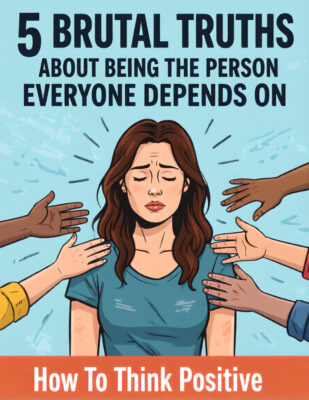
There’s something nobody tells you about being dependable: it’s a trap that feels like a compliment.
This post contains Amazon affiliate links, meaning I may earn a small commission if you purchase through my links, at no extra cost to you. Note: We aim to provide accurate product links, but some may occasionally expire or become unavailable. If this happens, please search directly on Amazon for the product or a suitable alternative.
When people consistently turn to you in their darkest moments, when your phone buzzes with crisis after crisis, when you’re the first person everyone calls—it feels good at first. It feels like purpose. Like you matter. Like you’re making a real difference in people’s lives.
But underneath that validation lies a harsh reality that most people will never acknowledge, and you’ve been too exhausted to admit.
Being the person everyone depends on comes with a cost that nobody warns you about. It’s time someone told you the truth—not to discourage you from caring, but to help you understand why you feel the way you do and what you need to change before you completely burn out.
Here are five brutal truths about being everyone’s go-to person that nobody has the courage to say out loud.
Brutal Truth #1: Most People Don’t Actually Want Your Help—They Want Your Emotional Labor
Let’s be honest about what’s really happening in most of these interactions. When people come to you with their problems, how often do they actually follow your advice? How many times have you spent an hour talking someone through a situation, only to watch them do the exact opposite of what you suggested? Or worse, watch them come back two weeks later with the same problem, expecting you to rehash it all over again?
The uncomfortable reality is that many people aren’t seeking solutions—they’re seeking emotional regulation that they haven’t learned to provide for themselves. You’ve become their external coping mechanism, their emotional support animal, their therapist without the professional boundaries or compensation. They’re outsourcing their emotional processing to you because it’s easier than doing the internal work themselves.
This doesn’t make them bad people. But it does make the dynamic unsustainable. You’re not actually helping them grow stronger; you’re enabling them to avoid developing their own emotional resilience. And in the process, you’re depleting yours.
Brutal Truth #2: Your Availability Has Taught People You Have No Limits
You did this to yourself—and that’s not a judgment, it’s an observation. Every time you answered that late-night call when you were exhausted, every time you dropped what you were doing to manage someone else’s crisis, every time you said “yes” when you meant “not right now,” you were training people that your boundaries don’t exist.
People will take as much as you give. That’s not malicious; it’s human nature. When you consistently demonstrate that your time, energy, and emotional bandwidth are infinitely available, people stop considering whether it’s a good time to ask. They stop wondering if you might be going through something too. They stop checking if you have the capacity.

You’ve become so good at showing up that people have forgotten you’re a person with your own limitations. And now, when you try to set boundaries, it feels like you’re letting people down—because you’ve spent so long teaching them that you never run out of space for their needs.
The brutal truth? You have to disappoint people to recalibrate their expectations. There’s no gentle way to establish limits you’ve never enforced before.
Brutal Truth #3: Being Needed Isn’t the Same as Being Valued
This one stings, but you need to hear it: many of your relationships are transactional, and you’re on the losing end of the transaction.
Being needed feels intimate. It feels like connection. It feels like love. But need and value are not the same thing. People need a gas station when their tank is empty, but they don’t value it—they just use it and drive away.
Ask yourself this hard question: In your closest relationships, are you valued for who you are, or are you valued for what you provide? Would these people still be in your life if you stopped being useful? If you were the one going through a crisis and needed support for six months straight, would they show up with the same consistency you’ve shown them?
The people who truly value you check on you without being prompted. They notice when you’re struggling even when you don’t say anything. They ask what you need, not just what you can do for them. They show up for you in the small moments, not just when they need something.
If you’re surrounded by people who only appear when they need support and disappear when their crisis passes, you’re not building relationships—you’re running a free emotional support service.
Brutal Truth #4: You’re Using Other People’s Problems to Avoid Your Own
Here’s where things get really uncomfortable. Have you considered that constantly fixing other people’s lives might be your way of avoiding the work you need to do on your own?
When you’re busy managing everyone else’s drama, you don’t have to sit with your own pain. When you’re focused on solving their problems, you can ignore the ones in your own life that feel too big or too scary to face. Being needed gives you purpose, which means you don’t have to answer the terrifying question: “Who am I when I’m not useful to someone?”
This is called codependency, and it’s not generosity—it’s avoidance dressed up as altruism. You’ve convinced yourself that you’re just a caring person, but the compulsive need to fix and save others often stems from an inability to sit with your own discomfort or a fear of being ordinary, unnecessary, or alone.
🎁 Want Even MORE Value? Download the Enhanced PDF!
These five brutal truths might have hit hard—but awareness is just the beginning. Get the enhanced PDF version with everything you need to transform these insights into real change in your life.
Here’s what you’ll get in the enhanced version:
✅ The Complete Article – A beautifully formatted, printable version you can revisit whenever you need a reality check.
✅ The Exclusive “Brutal Truths Reflection Worksheet” – Includes the relationship value assessment, boundary audit, and self-rescue action plan.
✅ All 10 Advanced Tips – For breaking codependent patterns and establishing healthy helping boundaries.
✅ Key Takeaways as Powerful Reminders – Formatted to keep you accountable to your own wellbeing.
Stop waiting for permission to prioritize yourself.
📥 Download Your Free Enhanced PDF Now
Join the How To Think Positive newsletter, where we deliver regular insights and practical tools for breaking people-pleasing patterns and building relationships where your needs actually matter!
The truth is that truly healthy people don’t need to be needed. They choose to help from a place of overflow, not obligation. They can sit with other people’s struggles without taking them on. They can witness pain without believing they’re responsible for fixing it.
If the thought of not being someone’s support system fills you with anxiety or makes you feel worthless, that’s not compassion—that’s codependency. And it’s time to examine why your self-worth is so deeply tied to being indispensable.
Brutal Truth #5: No One Is Coming to Save You—You Have to Save Yourself
You keep waiting for someone to notice how tired you are. You keep hoping that eventually, people will realize you need support too. You’ve been giving and giving, unconsciously expecting that this karmic bank will pay out, that all this generosity will be reciprocated when you need it most.
But here’s the brutal reality: it probably won’t be.
The people who lean on you have come to see you as fundamentally different from them—stronger, more capable, less in need of support. You’ve performed competence so convincingly that they genuinely believe you’re fine. And even if they do notice you’re struggling, many of them lack the capacity or skills to support you the way you’ve supported them, because they’ve never had to develop those muscles.
You cannot keep pouring from an empty cup while waiting for someone to fill it for you. You cannot keep sacrificing your wellbeing while hoping someone will eventually force you to rest. You cannot keep setting yourself on fire to keep others warm while praying someone will notice you’re burning.
The person who needs to check on you is you. The person who needs to enforce your boundaries is you. The person who needs to prioritize your wellbeing is you.
No one else is going to do it, and that’s not because they don’t care—it’s because you’ve never shown them it needs to be done.
What Comes Next: Rebuilding from Brutal Honesty
These truths are hard to swallow because they require you to fundamentally reconsider your role in other people’s lives and their role in yours. They demand that you question whether your helping is actually helping, or whether it’s just a comfortable pattern that lets everyone avoid growth—including you.
But awareness is the first step toward change. Now that you see these patterns clearly, you can make different choices. You can start saying no without guilt. You can let people experience the natural consequences of their decisions. You can distinguish between genuine emergencies and manufactured drama. You can build relationships based on mutual value, not one-sided need.
Most importantly, you can start showing up for yourself with the same fierce dedication you’ve shown for everyone else. You can learn to be okay with being ordinary, with not being needed, with taking up space without earning it through constant service.
Being dependable is a beautiful quality. But being dependable at your own expense isn’t noble—it’s self-destructive. You deserve relationships where care flows both ways, where your needs matter as much as theirs, and where your value isn’t determined by your usefulness.
It’s time to stop being everyone’s hero and start being your own.
FAQ
Q1: Does recognizing these truths mean I should stop helping people altogether?
A: Absolutely not. It means helping from a place of genuine choice rather than obligation or codependency. Healthy helping has boundaries, comes from overflow rather than depletion, and doesn’t require you to sacrifice your own wellbeing. You can still be a supportive person while also being selective about when, how, and whom you help.
Q2: How do I know if I’m codependent or just a naturally caring person?
A: Caring people can walk away when someone doesn’t want help; codependent people can’t. Caring people help without expecting specific outcomes; codependent people feel responsible for fixing the situation. Caring people maintain their own wellbeing while supporting others; codependent people sacrifice themselves and feel resentful. If saying “no” fills you with panic or if you feel worthless when you’re not helping someone, that’s a strong indicator of codependency.
Q3: What if people get angry or distance themselves when I start setting boundaries?
A: Then you’ve learned something valuable—they valued what you provided more than who you are. This is painful but necessary information. Real friends will respect your boundaries even if they need time to adjust. People who only wanted your emotional labor will leave, and that’s actually a good thing because it clears space for reciprocal relationships.
Q4: How can I tell the difference between a genuine emergency and manufactured drama?
A: Ask yourself: Is this actually an emergency or does it just feel urgent to them because they haven’t planned ahead or addressed recurring issues? True emergencies are rare and unpredictable. If someone has the same “emergency” every month, it’s a pattern they’re not addressing. If they’re asking you to drop everything for something that could wait a few hours or that they could handle themselves with effort, it’s manufactured urgency.
Q5: I’ve realized I’ve been avoiding my own problems—where do I even start fixing that?
A: Start by creating space away from other people’s problems. Schedule time where you’re completely unavailable to help anyone, and in that space, sit with your own thoughts and feelings without distraction. Consider therapy to work through why you’ve needed to be needed. Make a list of areas in your own life you’ve been neglecting. Start small—pick one thing you’ve been avoiding and commit to addressing it before you help anyone else with anything non-urgent.