


You’ve probably heard it before: visualize your dreams, think positive thoughts, and the universe will deliver everything you desire. The Law of Attraction has become a cultural phenomenon, promising that your thoughts alone can manifest wealth, love, and success. But here’s the uncomfortable truth—if manifestation were really that simple, you’d already have everything you want.
This post contains Amazon affiliate links, meaning I may earn a small commission if you purchase through my links, at no extra cost to you. Note: We aim to provide accurate product links, but some may occasionally expire or become unavailable. If this happens, please search directly on Amazon for the product or a suitable alternative.
The reality is far more nuanced than the glossy promises suggest. While there’s genuine value in maintaining a positive mindset and setting clear intentions, the popular interpretation of the Law of Attraction often sets you up for disappointment, self-blame, and magical thinking. Let’s pull back the curtain on some of the most pervasive myths surrounding this philosophy and explore what actually works when it comes to creating positive change in your life.
Myth #1: Positive Thinking Alone Will Transform Your Reality
This is perhaps the most damaging misconception perpetuated by Law of Attraction advocates. You’ve been told that if you just think positive thoughts consistently enough, your dreams will materialize. The implication? If you’re struggling, it must be because you’re not thinking positively enough.
The Truth: Positive thinking is beneficial, but it’s not a magic wand. Research in psychology shows that optimism can improve your resilience, health outcomes, and overall well-being. However, positive thoughts without action are just daydreams. You can visualize your ideal career all day long, but if you don’t update your resume, network, or develop new skills, you’re not moving any closer to your goals.
Moreover, the emphasis on relentless positivity can be toxic. It invalidates genuine emotions and creates what psychologists call “toxic positivity“—the overgeneralization of a happy, optimistic state that dismisses authentic human emotional experiences. When you’re going through hardship, telling yourself to “just think positive” doesn’t address the real issues you need to confront. Sometimes you need to acknowledge what’s wrong, process difficult emotions, and take practical steps to solve problems.
Myth #2: The Universe Is Conspiring to Give You What You Want

The romantic notion that the universe is personally invested in your happiness is comforting, but it’s fundamentally flawed. This myth suggests that if you align your vibrations correctly, cosmic forces will rearrange circumstances in your favor.
The Truth: The universe isn’t conspiring for you or against you—it simply is. Attribution of intentionality to random events is a cognitive bias called apophenia, where you perceive meaningful patterns in random data. When something good happens after you’ve been “manifesting,” you credit the Law of Attraction. When nothing happens, or something bad occurs, you’re told your vibration was off. This selective attention creates a confirmation bias that reinforces belief regardless of actual outcomes. You’re filtering your experiences through a lens that only counts the hits and ignores the misses. A more grounded approach recognizes that while you can’t control external circumstances, you can control your responses and actions. Your agency comes from the choices you make, not from cosmic intervention.
Tired of manifesting advice that sounds good but doesn’t work?
You’ve heard the stories and tried the techniques, but what if the real secret to the Law of Attraction isn’t just about thinking—it’s about a specific, hidden process?
Introducing The Law of Attraction: A Quick Guide to Your Hidden Manifesting Power eBook.
This isn’t a lengthy, abstract theory book. It’s your direct, practical blueprint to:
-
✅ Activate your true manifesting power by understanding the one element most guides leave out.
-
✅ Move beyond “positive thinking” into actionable, aligned steps that create real-world results.
-
✅ Debunk common myths that actually block your success and learn what to do instead.
Stop wondering why it works for others but not for you. Unlock the straightforward, no-fluff method to consciously create your reality.
Your hidden power is waiting to be unlocked.
Myth #3: If Bad Things Happen, You Attracted Them
This is where the Law of Attraction becomes particularly harmful. The logic goes: since you create your reality with your thoughts, any negative experience—illness, financial hardship, relationship problems, even trauma—must be your fault. You attracted it with your “negative energy.”
The Truth: This victim-blaming philosophy is not only cruel but psychologically dangerous. Bad things happen to everyone, regardless of their mindset. Illness, accidents, systemic injustice, and random misfortune are part of the human experience. Suggesting that victims of trauma, poverty, or discrimination somehow attracted their circumstances is not only insensitive but fundamentally misunderstands how the world works.
You don’t control everything that happens to you, and it’s damaging to believe you should. This myth can prevent you from seeking necessary help, whether that’s medical treatment, therapy, or practical assistance. It can also lead to profound shame and self-blame during already difficult times. A healthier framework acknowledges that while you can’t control every external event, you do have control over how you respond and what meaning you create from your experiences.
Myth #4: You Just Need to Believe It, and You’ll Achieve It

The Law of Attraction promotes the idea that unwavering belief is the key ingredient to manifestation. Doubt is portrayed as the enemy, the thing that blocks your desires from materializing. You’re told to “act as if” you already have what you want, and eventually, it will become real.
The Truth: Blind belief without evidence or action is delusion, not manifestation. While confidence can certainly help you pursue goals more effectively, research shows that realistic optimism—acknowledging challenges while believing in your ability to overcome them—is far more effective than unfounded certainty.
Psychologist Gabriele Oettingen’s research on mental contrasting demonstrates that simply fantasizing about positive outcomes can actually reduce your motivation to achieve them. When you only focus on the desired end result without considering the obstacles, your brain experiences premature gratification. You get the emotional reward without doing the work.
A more effective approach combines positive visualization with realistic planning. Imagine your goal, but also identify the obstacles you’ll face and create concrete strategies to overcome them. This technique, called WOOP (Wish, Outcome, Obstacle, Plan), has been shown to significantly increase goal achievement compared to positive thinking alone.
Myth #5: Material Wealth Is a Sign of Spiritual Alignment
The Law of Attraction has been co-opted by prosperity gospel thinking, suggesting that financial abundance is proof of your spiritual evolution and proper manifestation practice. Conversely, financial struggle indicates you’re doing something wrong or haven’t mastered the principles.
The Truth: Conflating wealth with worthiness or spiritual advancement is both materialistic and reductive. Many factors contribute to financial success, including socioeconomic privilege, education access, timing, market conditions, and yes—hard work and smart decisions. But attributing wealth solely to manifestation ignores systemic inequalities and the very real barriers many people face.
Furthermore, this myth creates a spiritual bypass where you avoid addressing practical financial issues—budgeting, investing, career development—in favor of “raising your vibration.” True financial wellness requires financial literacy, disciplined habits, and often uncomfortable work on your relationship with money. No amount of vision boarding by itself will balance your budget or negotiate your salary for you.
More concerning, this myth can make you vulnerable to exploitation. When teachers charge thousands of dollars for manifestation courses with the promise that you’ll attract wealth, they’re the only ones guaranteed to profit. If the course doesn’t deliver results, you’re told you didn’t believe hard enough—a perfect, unfalsifiable business model.
Stop Manifesting Wrong. Start Creating Right.
You just read the truth about what really blocks your manifestations. But here’s the thing—reading isn’t enough. Your brain needs repetition, reflection, and real action to rewire those old patterns.
That’s why I created something you can take everywhere: The Enhanced “Why Your Vision Board Isn’t Working: The Truth Behind 5 Law of Attraction Myths
” Guide (PDF format).
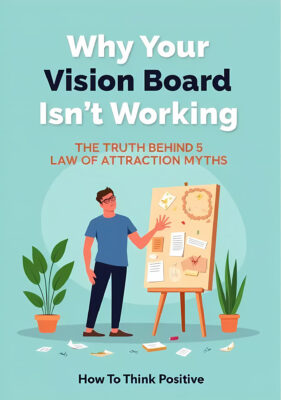
It’s your personal roadmap to stop attracting what you don’t want.
Here’s What You Get When You Sign Up for the How To Think Positive Newsletter:
✅ Exclusive Key Takeaways – The critical mindset shifts not included in the original article
✅ A Powerful Rewiring Exercise – A 10-minute practice to reprogram your subconscious (because thinking alone won’t cut it)
✅ Bonus Tips for Stubborn Blocks – What to do when manifestation still feels impossible
✅ Portable PDF Format – Read on the go, revisit when doubt creeps in, share with friends who need this wake-up call
✅ Weekly Newsletter – No toxic positivity. Just real strategies to think positive and take action
The universe doesn’t reward waiting. It rewards movement.
👉 Download Your Enhanced Guide 👈
Your thoughts built the door. Now kick it open.
What Actually Works: A Grounded Approach to Creating Change
So if the Law of Attraction as commonly taught is flawed, what should you do instead? The good news is that many of the underlying principles, when properly understood and applied, can be genuinely helpful.
Clarity and Intention: Getting clear about what you want is valuable. Writing down your goals, creating vision boards, and regularly revisiting your intentions keeps them front-of-mind and helps you recognize opportunities aligned with your values. Just don’t stop there.
Strategic Action: Pair your intentions with concrete action steps. Break big goals into manageable tasks. Create timelines. Hold yourself accountable. Your thoughts set direction, but your actions create momentum.
Psychological Priming: What you focus on shapes your perception. When you’re actively thinking about a goal, you naturally become more attuned to resources, people, and opportunities that can help you achieve it. This isn’t magic—it’s selective attention and confirmation bias working in your favor.
Growth Mindset: Believe in your ability to learn and grow rather than believing outcomes are predetermined by your thoughts. When you encounter obstacles, view them as information and opportunities to adjust your approach, not evidence that you’re manifesting wrong.
Self-Efficacy: Cultivate genuine confidence based on developing skills, learning from failures, and recognizing your actual agency. You’re not attracting success from the universe—you’re creating it through informed choices and persistent effort.
Emotional Regulation: Instead of suppressing negative emotions in pursuit of constant positivity, develop healthy ways to process difficult feelings. Emotional awareness and regulation are far more valuable than forced optimism.
Moving Forward With Eyes Wide Open
The appeal of the Law of Attraction is understandable. In an uncertain world, the promise that you have control over your destiny through your thoughts alone is comforting. But real empowerment comes from understanding what you genuinely can control and accepting what you cannot.
You have agency over your actions, your responses, your effort, and your choices. You can develop skills, build relationships, and create opportunities. You can maintain hope while acknowledging challenges. You can pursue your dreams while staying grounded in reality.
What you can’t do is think your way into a different life without taking the necessary steps to build it. The universe isn’t listening to your thoughts, but you are. And perhaps that’s the real power—not that your thoughts attract external circumstances, but that they shape your internal state, inform your decisions, and ultimately influence the actions that determine your path forward.
So by all means, visualize your goals, maintain a positive outlook when possible, and set clear intentions. But then get to work. Take the classes. Have the difficult conversations. Make the budget. Send the emails. Show up consistently. That’s where the real magic happens—not in the thinking, but in the doing.
5 Frequently Asked Questions About the Law of Attraction
1. Does the Law of Attraction work at all, or is it completely false?
The Law of Attraction as popularly taught—that your thoughts alone manifest reality—isn’t supported by evidence. However, some underlying principles do work. Setting clear intentions helps you recognize relevant opportunities (psychological priming), and optimism can improve your resilience and decision-making. The key is pairing these mental practices with strategic action. Think of it this way: your thoughts don’t attract outcomes, but they do influence your behavior, which shapes your results.
2. If I visualize my goals, am I wasting my time?
Not necessarily. Visualization can be helpful when done correctly. The problem is visualizing only the positive outcome without considering obstacles. Research shows this actually reduces motivation. Instead, use mental contrasting: visualize your goal, then identify potential obstacles, and create concrete plans to overcome them. This WOOP method (Wish, Outcome, Obstacle, Plan) is far more effective than fantasy alone.
3. What about all the success stories from people who swear the Law of Attraction worked for them?
You’re seeing confirmation bias in action. People remember and share the times things worked out after “manifesting,” but conveniently forget the countless times nothing happened. They’re also often downplaying the actual work they did—the networking, skill-building, and strategic decisions—and attributing success solely to their thoughts. Correlation isn’t causation, and anecdotes aren’t evidence.
4. Is it wrong to use affirmations or vision boards?
Not at all! Affirmations and vision boards can be useful tools for clarifying your values and keeping goals front-of-mind. The problem arises when you treat them as magical solutions rather than motivational tools. Use them to inspire action, not replace it. Your vision board should prompt you to ask, “What’s one thing I can do today to move toward this goal?” rather than, “When will the universe deliver this to me?”
5. How do I stay positive without falling into toxic positivity?
You don’t need to be positive all the time—that’s the trap. Healthy emotional regulation means acknowledging your full range of feelings, including anger, sadness, and frustration. These emotions provide valuable information about your needs and boundaries. Instead of forcing positivity, practice realistic optimism: acknowledge challenges while believing in your capacity to navigate them. Allow yourself to feel difficult emotions, process them, then refocus on what actions you can take. Authenticity beats forced cheerfulness every time.